

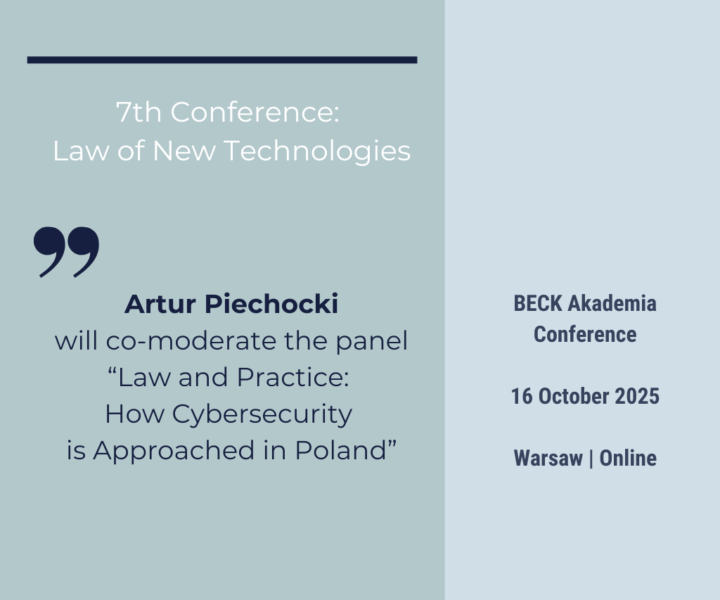
We invited participants to one of the most important events in Poland dedicated to legal regulations in the field of new technologies, featuring attorney-at-law Artur Piechocki. On 16 October 2025, the 7th Conference: Law of New Technologies – Current Issues and New Challenges, organized by C.H. Beck (Beck Akademia), took place. The aim of the event was to foster knowledge exchange between lawyers, business leaders and technology experts to better understand the real threats and challenges organizations were facing.
This edition placed particular emphasis on cybersecurity. Experts analyzed the impact of new regulations – the DORA Regulation and the NIS-2 Directive – as well as the role of artificial intelligence in protecting IT systems. Modern cyberthreats went far beyond traditional attacks, encompassing complex hybrid operations, organized crime activities, and even state-level actions aimed at acquiring strategic information or paralyzing critical infrastructure.
One of the moderators of the panel was attorney-at-law Artur Piechocki, who, together with Radosław Nożykowski, led a discussion featuring representatives of business and academia. The panel focused on how cybersecurity was approached in practice in Poland. Experts confronted experiences regarding the impact of new regulations on the operations of financial institutions and enterprises, shared practical insights from implementations, and addressed the key question of whether artificial intelligence was already transforming cyber risk management.
The conference provided a unique opportunity to look at cybersecurity from both a legal and technological perspective. Such dialogue enabled lawyers to better support their clients in risk management and compliance.
The conference was held in a hybrid format – onsite in Warsaw and online.
We also recommended watching the video announcement featuring Artur Piechocki.
W ramach naszej strony internetowej korzystamy z plików cookies. Pliki cookies umożliwiają nam zapewnienie prawidłowego działania naszej strony internetowej oraz realizację podstawowych jej funkcji, a po uzyskaniu Twojej zgody, pliki cookies są przez nas wykorzystywane do dokonywania pomiarów i analiz korzystania ze strony internetowej, a także do celów marketingowych.

